How to get started with Journey Management
Danish organizations are among the most digitized in the world. But if you look behind the scenes, many are still struggling with systems and budgets locked away in individual silos. Unfortunately, this ends up hurting the customer experience, and great digital initiatives often fail to deliver the impact everyone expected.
Journey Management is a strategic direction that can tie an organization together horizontally, ensuring the customer experience doesn't get fragmented by your internal structures.

Rasmus Berrig
CX, director
Date published:
Length:
10 min. read
What is Journey Management – and why is it more important than ever?
Denmark consistently holds a top global spot in digitalization. Infrastructure like MitID and e-Boks has accustomed Danish users to high levels of efficiency and coherence. Similarly, many commercial enterprises have invested heavily in omnichannel experiences and digital initiatives. Despite this, many customers still find their interactions with both private and public organizations to be disjointed, ultimately resulting in a poor experience.
Journey Management is a discipline that ensures coherence by shifting the focus from standalone digital projects to the dynamic management of the overall customer experience, including internal processes and collaboration. It is not a confined project, but a form of leadership and governance.
Companies that truly commit to being customer centric are winning. They create better experiences, and that shows up directly on the bottom line: lower cost-to-serve, higher NPS, increased revenue, and stronger loyalty. Journey Management can help strengthen the overall customer focus.
The Danish reality: Four dominant organizational models
To understand why cross-functional work is so difficult, we have to look at how companies are typically structured. Even with a modern, informal workplace culture, the underlying structures often work against a seamless customer journey.
Here are the four models we see most often:

Model 1: The functional structure
This is where the organization is split by expertise: Sales, IT, Finance, and Customer Service each have their own leadership and their own goals. You see this a lot in the public sector and in traditional operations-heavy companies.
The Pros: It ensures high specialization and stability. Everyone knows exactly who is responsible for what.
The Challenges: It creates silos. IT solutions often end up reflecting internal departments rather than customer needs. And budgets? They’re usually locked into daily operations rather than cross-functional improvements.

Model 2: The Matrix organization
Here, employees report to both a functional manager and a market or project manager. This is the standard for many large corporations.
Pros: Makes it possible to maintain professional depth while coordinating across projects and/or markets.
Challenges for the customer journey: Can lead to complex decision-making processes. In an organization with multiple reporting lines, this often results in excessive coordination meetings and unclear mandates. Organizations often introduce CX roles, but these frequently lack the mandate over the resources required to create real change. Budgeting challenges also arise when the customer journey spans multiple departments.

Model 3: Hub & spoke
Strategy and heavy resources are centralized in a "Hub," while execution happens out in the "Spokes" (the business units). This is great for companies with different divisions that still want shared standards.
Pros: It ensures consistent standards and shared data, while local teams stay close to their specific markets.
Challenges for the Customer Journey: Bottlenecks often occur in the hub if central teams become a roadblock for progress. Likewise, individual departments often begin building their own technical solutions outside the hub to increase speed (shadow IT and fragmented journeys), like incentives in the hub vs. spoke often conflict.

Model 4: The Product-Centric Model
Here, employees are organized into autonomous, cross-functional teams (Tribes) that own a product or a journey from start to finish. This is popular in tech-heavy or innovative environments.
Pros: Provides high speed from idea to launch, as the team has all necessary competencies gathered and does not have to wait for other departments.
Challenges for the Customer Journey: You risk creating "product islands." If one team only optimizes their specific slice of the pie without talking to the others, the customer ends up with a digital experience that feels completely different from one screen to the next.
In Reality, we deal with hybrid models
Few organizations follow one model strictly. Most are a mix, trying to balance running the core business with the need to innovate.
But it’s in this tension that problems arise. A customer might see a company that looks modern and fast on their phone, but the underlying support is still bogged down by heavy, manual processes. Internally, budget processes can become even murkier.
This is where Journey Management acts as the glue that holds it all together.
It sounds simple, but how is Journey Management operationalized?
When a customer has a bad experience, it’s rarely because the employees aren't trying. It’s usually because the responsibility for that part of the journey is unclear, spread across too many departments, or hidden from leadership.
The value of Journey Management lies in connecting customer behavior (insights, pains, and gains) with internal processes (service blueprints) and the overall business strategy.
Why is it often difficult to create momentum? Even though most leadership teams acknowledge the need, initiatives often struggle to gain traction. Maybe you can recognize some of them?
Project-driven only approach: The work is treated as a project with an end date. Once finished, the organization reverts to its usual silos without using learnings to build the change needed.
Static journey maps: When the approach is project-driven, the journey is typically developed as a static map. However, this snapshot quickly becomes obsolete instead of being linked to the company's operating model.
Lack of structure: A major advantage of Journey Management is creating a deep structure of the overall customer journey in a "Journey atlas." This makes it significantly easier to operationalize initiatives into smaller parts, which is difficult with a large, static journey map.
Internal resistance: Change is uncomfortable. When you start working across silos, people often worry about losing control over their specific areas or budgets. If the team feels that Journey Management is just another way to criticize their work, they’ll naturally push back.
Lack of mandate: Without executive buy-in, those responsible lack the authority to make decisions that cross departmental processes, business rules, and budgets.
Lack of measurement: If the work is not linked to concrete goals and KPIs, it becomes difficult to justify resource allocation and even harder to evaluate success.
When we help companies get started, we look at how they are organized and what existing rituals we can build on. The path forward depends on your maturity:
Phase 1: The challenge project – test and evaluate
The first step is about proving value quickly. Select one specific, business-critical problem and assemble a cross-functional team with the mandate to solve it across existing departments. The goal is not to map everything, but to establish the foundation for the methodology and structure of Journey Management, while solving a critical problem with measurable results that can serve as a lever for the next step.
Phase 2: Center of excellence – leverage existing structures
Once initial proof is established, the effort must be systematized through a central unit. Here, existing structures are often utilized to define frameworks and tools. The goal is to build out a Journey Framework and a shared taxonomy so that everyone involved in Journey Management works with the same language and the same view of data. Here, the mandate resides within the methodology and central governance, but still dependent on other departments
Phase 3: Journey led – Integration into the organization
The final step is to make Journey Management a permanent part of the operating model. Journey Owners are appointed with overall responsibility for parts of the customer journey, including mandate, resources, and cross-functional KPIs. They are not an independent department but a part of daily management with a permanent voice when resources and IT development are prioritized. Here, the mandate is decentralized, ensuring customer needs are weighted equally with departmental interests.
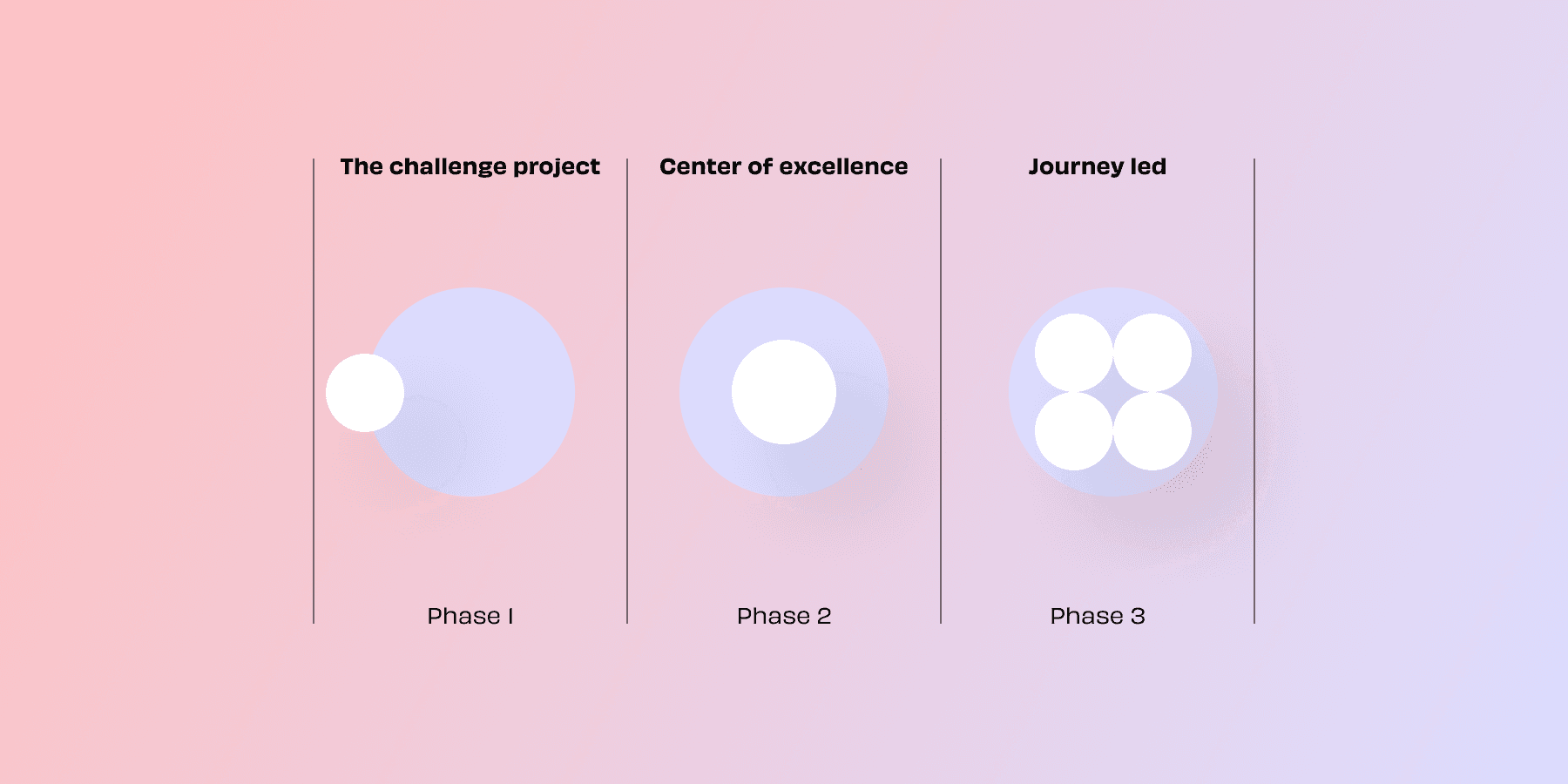
How we usually see the progression of Journey Management
How to get started? The challenge project first steps
A successful challenger must prove that cross-functional collaboration creates measurable results. The main requirements for getting started are:
Identify a current problem: Choose a challenge that negatively affects the customer and incurs internal costs. It must involve at least two departments (e.g., IT and Sales).
Build a strong business case: To get executive buy-in, create a case that highlights the problem and the business benefits the project will provide. This makes evaluating the effort significantly easier.
Assemble the right team: Establish a team with the mandate to act and secure an executive sponsor who can prioritize the project over daily operations.
Use hard data: The project must be measured with concrete numbers, such as fewer support tickets, higher conversion rates, or reduced support handling time.
Use the result as proof: When the project shows results, it serves as the business case to scale the effort to other critical areas of the organization.
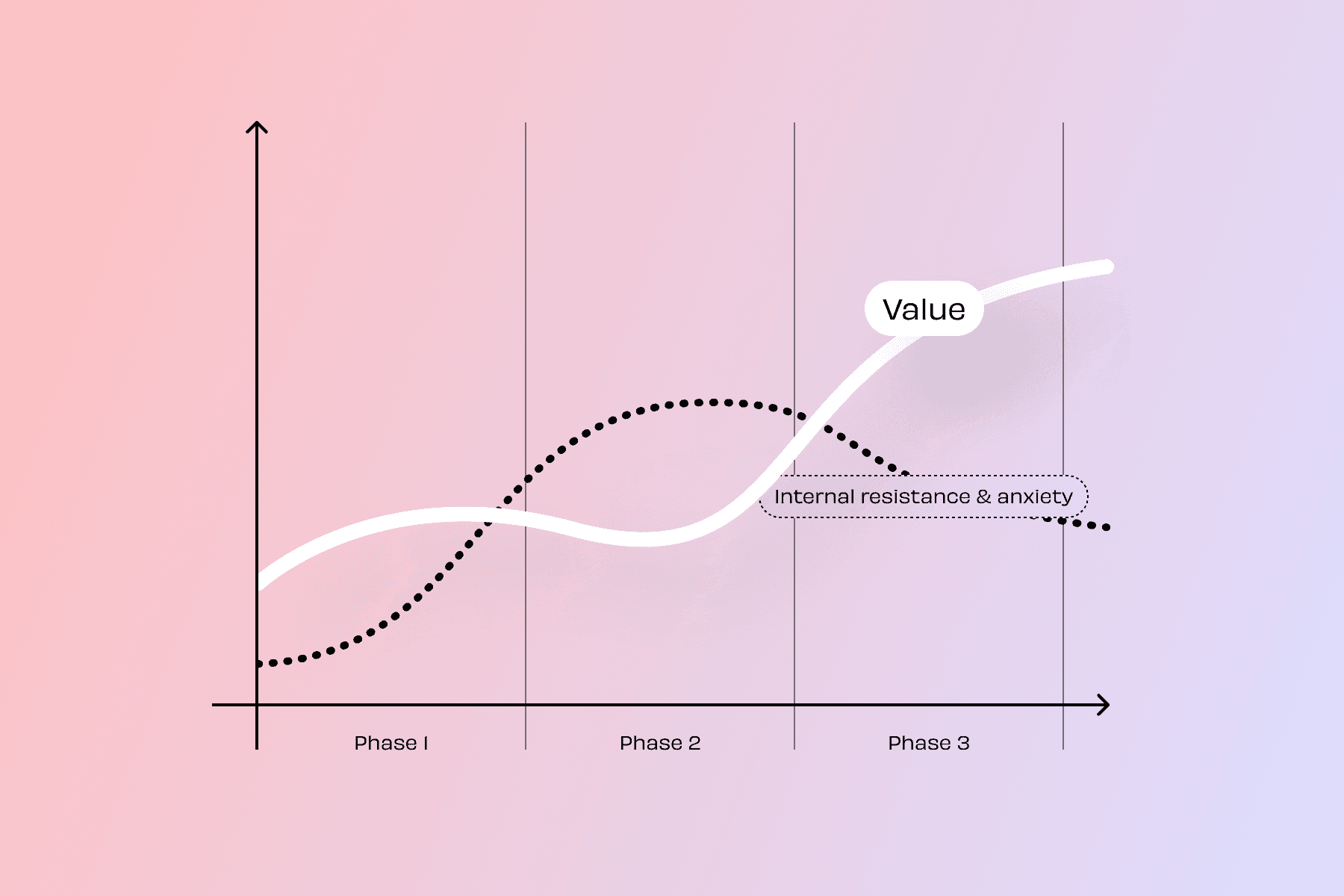
When implementing Journey Management you have to consider governance processes to succeed
From coordination to embeddedness
The greatest challenge in Journey Management is not mapping the journeys, or ensuring short-term wins but ensuring real collaboration across the board. The most competitive companies of the future are those that manage to organize their internal processes according to the customer experience rather than their own internal needs alone.
Next step for you: Consider an area or point in your value chain where the handoff between departments most often fails and has a negative effect on the customers, and start the dialogue there. It is usually where it hurts a bit that the greatest gains and opportunities are found.

Katrine Ly
Service Design, Partner