The future of the designer and why AI is great news for our field
AI is getting faster and better at taking over practical tasks. But what does that actually mean for those of us who make a living creating digital designs and customer experiences? Should we go on the defensive, or is it time to reinvent ourselves?
Here is my take on why we are actually heading into a very exciting time.

Rasmus Berrig
CX, director
Date published:
Length:
5 min. read
New possibilities emerge
First, let’s get one thing straight: When I say “the designer,” I’m using the term broadly. I’m talking about you. Whether you work in CX, UX, Service Design, or Digital Design.
I recently came across a post on LinkedIn where someone wrote:
“The UX designer is dead because AI can now build complicated wireframes in no time.”
He’s right about the second part.
Wireframing, UI components, and research have rapidly become commodities. With tools like Claude or Lovable, you can go from idea to product in record time.
But is the designer dead? I don’t believe that for a second.
Quite the opposite.
I believe we’re standing in front of brand-new opportunities. We just need to move away from being "executors" and toward becoming an “X-shaped profile.” A profile that thinks more about strategy and business, and acts as the glue that holds the entire organization together.
Remember the webmaster?
This isn't the first time our role has changed. I’m old enough to remember when anyone working with websites was simply called a "Webmaster" for lack of a better term. Back then, you did a bit of everything: Graphics, code, design, and copy. You covered a lot of ground, but you rarely went deep.
As things got more complex, we became specialists. We got UX researchers, UI designers, and all the other specific roles.
But now, the tide is turning again. AI handles specialist tasks so quickly that companies can launch new products faster than ever. And that creates a new kind of mess. Because who ensures:
That we’re launching the right thing for the customers?
That we’re using AI wisely - both internally and for the users?
That we keep the human touch in a world becoming even more digitized?
I don’t think the need for specialists will ever fully disappear, but it will likely decline over time. In its place, there will be a massive need for those who dare to look up and see the big picture. That’s where the X-shaped profile comes in: Someone who combines their craft with other specializations like deep technical understanding or business design.
When the experience is driven by logic
If AI takes over the heavy manual lifting like research, structure, and maintaining design systems what are we going to do? We need to focus (even) more on:
The direction: Tying the customer experience to the company’s strategy.
The dialogue: AI has the data, but we have the empathy and the understanding of the emotions behind it.
The logic: Designing the rules and frameworks that autonomous systems must act within.
The ethics: For example, where do we draw the line on personalization and data collection?
The value: Translating user needs into actual business cases.
The behavior: Being the internal link that connects the customer journey to the organization.
We are moving from being the ones who build products to being the ones who orchestrate the entire experience.
An example: When design becomes business-critical
McKinsey highlights an example from a US airline that shows this shift perfectly:
The old world: Flight canceled. Customer calls support, waits two hours on hold, and is furious.
The new world (Design-led): An AI agent proactively rebooks the customer on a partner flight, sends a hotel voucher, and deposits 5,000 miles into their account instantly.
The result? An 800% increase in customer satisfaction.
Who gets the credit?
The design and business design team. They were the ones who identified the problem, mapped out the experience, and designed the logic: "If delay > 4 hours, provide hotel + miles."
(Source: McKinsey - Agents for Growth. Link: https://www.mckinsey.com/capabilities/growth-marketing-and-sales/our-insights/agents-for-growth-turning-ai-promise-into-impact)
Why the designer isn’t dead
AI is here to stay. And we stand stronger if we move up the value chain.
According to McKinsey, companies that integrate design strategically see up to twice as much growth as their competitors. Meanwhile, Gartner predicts a wave of issues in 2026 where companies will get into trouble due to poor AI decisions.
This is where the designer becomes indispensable. As the person who ensures accountability and sets up the necessary guardrails.
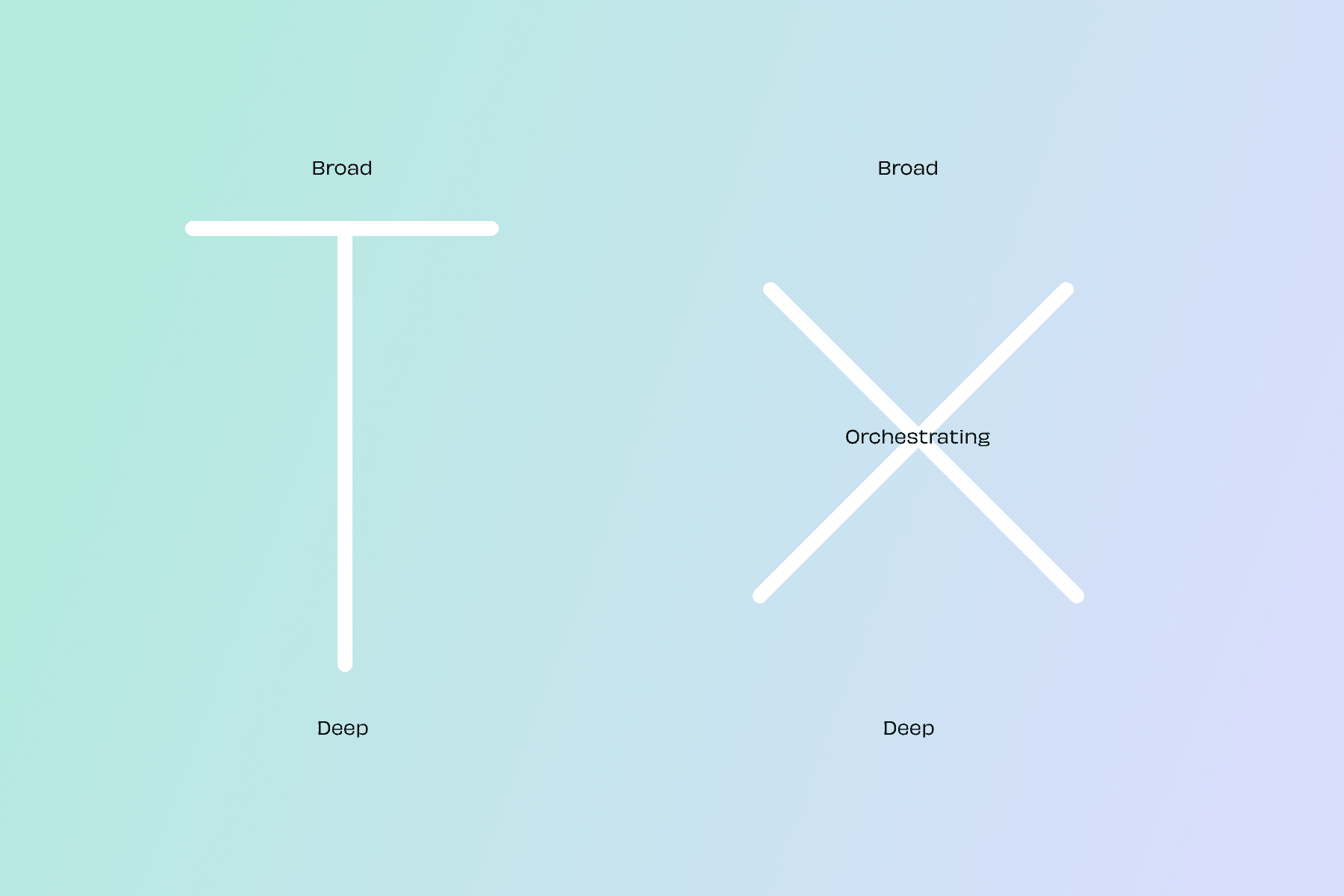
T-profile vs. X-profile
The new profile: X-shape instead of T-shape
For a long time, the T-shaped profile was the ideal. But the future belongs to the X-shaped profile, standing firmly at the intersection of:
Design & empathy (Understanding the human intentions and behavior)
Tech & data (Understanding the possibilities)
Business (Understanding business models and value streams)
Leadership (The ability to drive change)
No one else in the organization is trained to look across silos like we are. We are used to mapping journeys and seeing the big picture.
That’s why I believe the role of the designer in the future will be the essential "glue" in the organization.
A concrete discipline for this is Journey Management. By using Journey Management as a lever, companies can drive the necessary changes across silos and ensure that technology serves both the customers and the business.
This gives us a unique position. The opportunity is right in front of us.